
Accessible Bathroom Remodeling
When changing mobility makes a bathroom difficult or unsafe to use, the right solution isn't the same for everyone.
We start by understanding the person—their abilities, routines, what matters today and what may change tomorrow. Then we design an accessible bathroom around them, supporting safety, independence and dignity without sacrificing comfort, beauty or the feeling of home.
No two people are identical. Their bathrooms shouldn't be either.
Let's Talk About What You Need
Designing Around People
The Right Solution Looks Different for Everyone
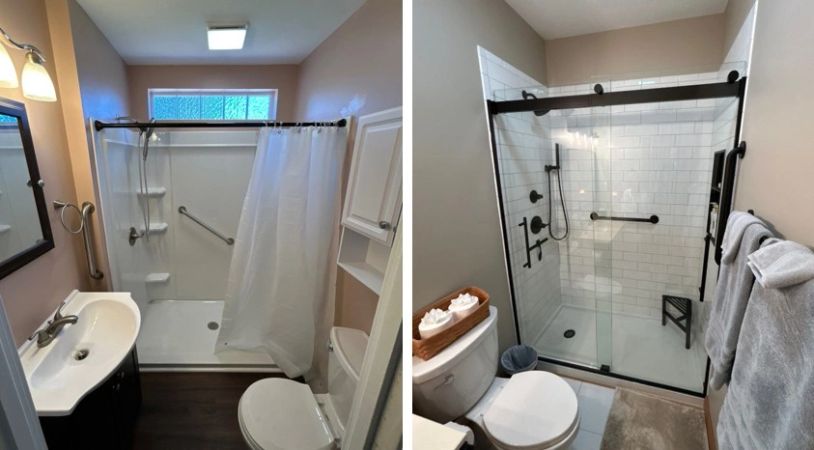
Two of our customers needed bathrooms designed around very different physical needs.
One was shorter and needed the shower controls and handheld shower comfortably within reach. Easy maintenance mattered, and a shower curtain provided a wider, less obstructed opening than glass doors. Her small bathroom was also dark, so we added a window above the shower to bring in natural light.
Another customer, at about 6'5", had spent years using shower heads that were simply too low. For him, we raised the shower head and created a tall tiled shower with glass doors—because accessibility, comfort and appearance all mattered.
Both bathrooms became more accessible, but that meant something very different for each person. Some of the features that helped one would have made the other's bathroom less accessible.
That's why we don't begin with a standard list of accessibility features. We begin with the person.

Thoughtful Accessibility is in the Details
Sometimes a feature that sounds accessible doesn't actually make the space more accessible.
A man in his 90s had difficulty navigating his existing bathtub. Our initial plan for his new shower included a shower seat and handheld shower—both sensible accessibility features. But when we thought through how he would actually use them, we realized our design was creating a new barrier.
With the seat at one end and the controls at the other, he would have needed to cross a wet shower floor to turn on the water, return to the seat, and then do it again when he was finished. The alternative was having someone else operate the shower for him—taking away some of the independence and privacy we were trying to preserve.
So we changed the design. We placed the controls and handheld shower within reach of the seat, allowing him to sit down and operate the shower himself.
The goal isn't to add accessibility features. It's to remove barriers. A shower seat, handheld shower, grab bar or low threshold is simply a tool. What matters is whether it's the right tool, in the right place, for the person using it.
That's why we think through the entire experience—not just the individual features.
Your Bathroom Should Still Feel Like Yours
Accessibility doesn't mean giving up the things that make your home feel like home.
One of our customers grew up in Mount Vernon admiring the grand historic houses in his neighborhood. Years later, he and his partner purchased one of those homes—a neglected historic house they could restore and make their own.
They filled it with antique furniture and historical portraits, carefully preserving the character that had drawn him to the house since childhood. But the clawfoot tub that belonged beautifully in a historic bathroom didn't work with his mobility. He needed a shower without a tub or threshold to step over.
A zero-entry tiled shower removed that barrier—but it also needed to belong in this house. We chose materials and finishes that provided the accessibility he needed while respecting the home's historic character.
Designing around people means understanding what they value, not just what their bodies require.
Accessibility didn't require choosing between the home he'd dreamed of and a bathroom that worked for him. Our job was to help the two work together.
Designing for a Lifetime

Most of us don't spend much time thinking about “aging in place” or how our homes will work as we get older—until life gives us a reason to.
My parents are building a new home just as my dad's mobility is beginning to change. That has given our family an opportunity to think ahead—and I've found myself asking questions I never imagined I'd be asking.
When we laid out Dad's shower, I had him sit in a chair so I could see where he could comfortably reach the controls and determine the right height for the shower seat. We've also talked about vanity placement, closet layout, door locations and how the floor plan will allow them to move comfortably through the house.
Some decisions matter today. Others may matter five or ten years from now. The goal isn't to predict exactly what Mom and Dad will need someday. It's to make thoughtful choices now that give them more options later.
This experience has reminded me of something important: Dad isn't fundamentally different from me. He's simply farther down the road.
I'm doing this for my dad now. I know when the time comes, my daughters will be doing the same thing for me—and someday their children may be doing it for them.
Our needs change over a lifetime. Our homes can be designed to change with us.
You Don't Have to Figure This Out Alone
Often, the person who calls us isn't the person who needs the work. It's a son or daughter trying to help Mom or Dad—and they may not know the right solution yet.
That's okay.
One recent customer needed to replace a badly worn bathtub that had become difficult to navigate. His daughter had secured VA funding for an accessible shower, but they needed a contractor willing to work through the VA process.
Sometimes advocating for a family means more than designing the bathroom. It means helping find a workable path forward.
The VA is one of several programs that may help families pay for accessibility improvements. We're not experts on these programs, but we're willing to work with them when they can help a family get the improvements they need.
And you don't need to know exactly what your bathroom needs before you call us.
Tell us about the person. Tell us what's getting in the way. Tell us what you're hoping life at home can look like. We'll start there.
Accessible Bathrooms We've Built
